Request Form
Emergency Case
Emergency hair loss care may be needed if you have had a blow to the face, lost a filling, or cracked a tooth.
- 0329-0011336
0327-0011335 - info@dotclinics.pk
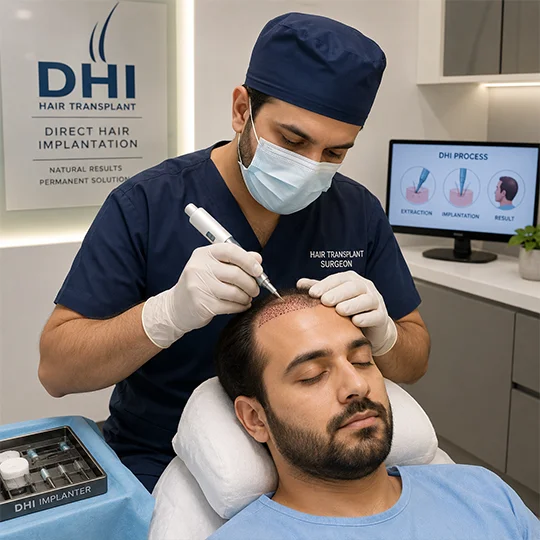
DHI Hair Transplant in Lahore
Natural Hairline & Permanent Results
Losing hair is not just about looks. It affects how you feel about yourself every single day. If you have tried oils, medicines, and home remedies and nothing worked, a DHI hair transplant may be the right answer for you. DHI, which stands for Direct Hair Implantation, is the most advanced hair transplant method available in Pakistan today. At Hair Transplant Clinic, our hair transplant surgeon in Lahore, Dr. Hamza Ahmad, performs this procedure with the precision of a plastic surgeon — not a technician. We offer DHI hair transplant in Lahore, giving people across Pakistan access to world-class hair restoration. If you want real hair that grows naturally, stays permanently, and looks like it was always yours, you are in the right place.
Hair Restoration Surgeon
License No.: 9001 | 14644 | 15189
8+ Years Experiece
100% Safe Results
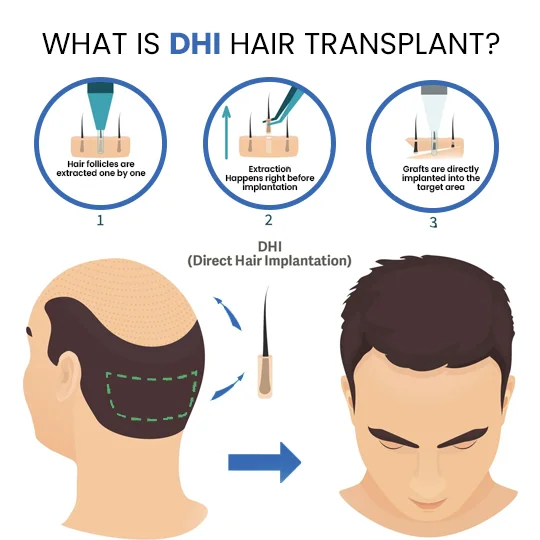
What Is DHI Hair Transplant?
DHI full form is Direct Hair Implantation. It is a type of FUE hair transplant (Follicular Unit Extraction) but with one important improvement. In a standard FUE procedure, the surgeon first makes small cuts in the scalp and then places hair follicles into those cuts as a separate step. In the DHI method, both steps happen at the same time using a special tool called the Choi Implanter Pen.
This pen works like a small syringe. The doctor loads a single hair follicle into it and then implants it directly into the bald area in one smooth movement, no separate cutting step, no open wounds waiting to be filled. This is why DHI is also sometimes called the Choi pen hair transplant.
What does DHI mean for your results? It means the hair follicle spends less time outside your body, which keeps it healthy. It means more control over the angle, direction, and depth of every single hair planted. And it means your final result looks completely natural, because every hair is placed exactly where it should go.
schedule a visitHow Does DHI Hair Transplant Work?
Many people want to know how hair implants are done before they book a consultation. Here is a simple, honest explanation of the full DHI hair implantation procedure at Dot Clinics.
Before anything else, Dr. Hamza Ahmad sits with you and studies your hair loss pattern, the condition of your donor area, and what kind of results are realistic for you. He then draws your new hairline by hand. This is important: a natural hairline is designed by a qualified hair transplant surgeon, not by a machine or a marketing claim.
The back of your head (called the donor area) has hair follicles that are genetically resistant to falling out. These are the follicles that will be moved to your bald or thinning spots. The doctor examines this area carefully to pick only the healthiest, strongest follicles.
You are given local anesthesia so you do not feel pain during the procedure. Most patients describe it as very comfortable. You stay awake the entire time and can rest or watch something while the team works.
You are given local anesthesia so you do not feel pain during the procedure. Most patients describe it as very comfortable. You stay awake the entire time and can rest or watch something while the team works.
Using a fine micro-punch tool, each hair follicle is removed one by one from the donor area. The follicles are immediately placed in a special chilled solution that keeps them healthy and alive outside the body. This is a critical step, the longer follicles sit exposed, the weaker they become. At Dot Clinics, we move quickly and carefully to protect every graft.
This is where DHI is different from all other methods. Each follicle is loaded into the Choi Implanter Pen and implanted directly into the recipient area. No pre-made incisions. No waiting. The doctor controls the angle, depth, and direction of every hair individually. This precision is what gives DHI its higher density and more natural look.
Once the procedure is done, you are given detailed instructions for the days and weeks ahead. Our team stays available for follow-up support throughout your recovery.

DHI vs FUE Hair Transplant
This is one of the most common questions patients ask. Both FUE and DHI are excellent techniques. Neither one is automatically better. The right choice depends on your hair loss condition, your goals, and your budget.
- Feature DHI (Direct Hair Implantation) FUE (Follicular Unit Extraction)
- How grafts are placed Choi pen, direct, one-step implantation Channel is made first, then graft is inserted
- Shaving required Partial shaving only in most cases Full shaving usually required
- Precision of placement Very high, angle and depth fully controlled Good, slightly less individual control
- Recovery time Faster Moderate
- Suitable for Early to moderate hair loss, hairline work, higher density goals Suitable for all hair loss stages including severe
- Cost in Pakistan Higher (PKR 150,000 – 400,000+) Lower
- Scarring Minimal, no linear scar Minimal, no linear scar
- Graft survival rate 90–95%+ 90–95%+
Both techniques deliver permanent, natural-looking results when performed by a skilled surgeon. DHI gives more precision in graft placement. FUE is a tried-and-tested method suitable for larger sessions and tighter budgets. At Hair Transplant Clinic, we help you choose the right method for your specific situation, not the one that earns us more money.
Who Is a Good Candidate for DHI Hair Transplant?
DHI hair transplant works best for people who:
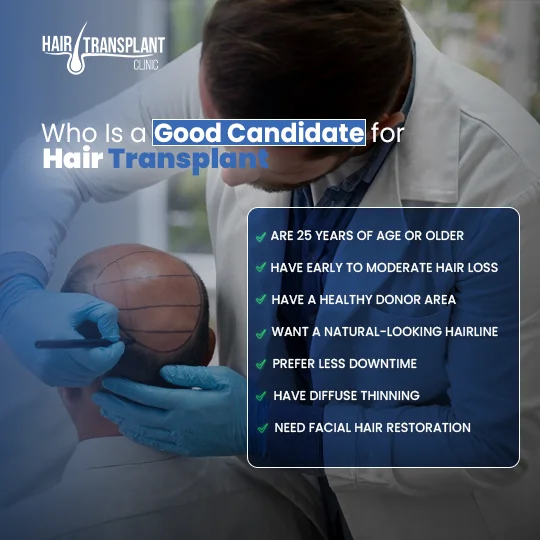
- Are 25 years of age or older: Hair loss patterns are usually more stable after the mid-20s, helping surgeons design a long-term hair restoration plan with better predictability.
- Have early to moderate hair loss: Patients within approximately Norwood Scale 2–4 are often ideal candidates because enough native hair remains to create natural density and coverage.
- Have a healthy donor area: Strong and dense donor hair at the back or sides of the scalp is essential for successful graft extraction and long-lasting results.
- Want a natural-looking hairline: Advanced hair transplant techniques can recreate soft, realistic hairlines with high-density placement for a natural appearance.
- Prefer less downtime: Modern hair transplant methods allow faster recovery with minimal disruption to daily routines and less visible post-procedure healing.
- Have diffuse thinning: Patients with thinning hair across larger areas, rather than completely bald patches, may achieve excellent blending and density improvement.
- Need facial hair restoration: Hair transplantation can also be performed for beard enhancement, eyebrow restoration, moustache reconstruction, and other facial hair areas.
DHI may not be the best choice if you have very advanced baldness requiring 4,000+ grafts in one session, because the Choi pen process takes more time per graft. In those cases, FUE or a combined approach may be recommended.
How Many Grafts Do You Need?
The cost of DHI hair transplant in Pakistan typically ranges from PKR 150,000 to PKR 400,000 or more, depending on the following factors:
- Number of Grafts Needed: The total graft count is the biggest factor affecting hair transplant cost. Larger sessions require more surgical time, graft preparation, and implantation work.
- Surgeon’s Qualifications: Procedures performed by experienced, board-certified plastic surgeons typically cost more due to their advanced training, surgical expertise, and higher standards of care.
- Clinic Reputation & Hygiene Standards: ISO-certified clinics with modern equipment, strict sterilisation protocols, and trained medical staff generally have higher operational costs that influence pricing.
- Clinic Location: Hair transplant pricing may vary between Lahore, Karachi, Islamabad, and other cities due to differences in operating expenses, demand, and facility standards.
Why Is DHI More Expensive Than FUE?
DHI takes longer per graft because every follicle is loaded and implanted one at a time with the Choi pen. It requires a highly skilled team. The tool itself is expensive. The precision it offers is exceptional, but that precision comes at a price. Think of it this way: DHI is to FUE what a fine handmade watch is to a regular watch. Both tell time. One is just made with more individual attention.
Is DHI Worth the Cost?
If you want maximum density, a very precise hairline, and faster recovery, and your hair loss is in the early to moderate range, then yes, DHI is worth every rupee. If budget is a concern, FUE gives excellent results too, and our team will tell you honestly which one makes more sense for you.
Not Sure If You Qualify?
Book a free, no-obligation consultation at our Lahore clinic. Our hair transplant doctor will assess your hair loss grade using the Norwood scale and tell you exactly what is achievable for your specific case.
You will receive a personalised treatment plan with graft estimates, technique recommendation, and transparent pricing — all at no cost.
Book Free ConsultationBenefits of DHI Hair Transplant
Here is why so many patients across Pakistan choose DHI as their preferred hair implantation method:
Natural-looking Results
Each follicle is placed at the exact angle of your natural hair growth. When your hair grows, it falls and moves exactly like natural hair.
No Pre-Made Cuts
Unlike older methods, the Choi pen creates its own channel as it implants. This means less trauma to the scalp.
Faster Recovery
Because there are no open incisions waiting to heal, the scalp recovers more quickly. Most patients see crusting fall off within a week.
Higher Graft Survival
Follicles spend minimal time outside the body. Studies and clinical experience both support a graft survival rate of 90 to 95% or higher with proper technique.
Suitable for Both Men and Women
DHI works for male pattern baldness, female hair loss, diffuse thinning, receding hairlines, and beard or eyebrow restoration.
Permanent Results
the transplanted follicles are taken from the DHT-resistant donor area. Once they grow in the new location, they keep growing for life with proper care.
Risks and Side Effects of DHI Hair Transplant
Like any medical procedure, DHI carries some minor risks. When performed by a qualified surgeon in a properly equipped clinic, serious complications are rare. You should know about:
- Temporary Swelling: Mild swelling around the forehead or scalp may occur during the first 2–3 days after the procedure and usually settles on its own.
- Redness & Tenderness: The implanted area may appear slightly red and feel sensitive for a few days as the scalp heals.
- Shock Loss: Transplanted hairs commonly shed within 2–4 weeks after surgery. This is a normal stage of the growth cycle, and new hair usually starts growing from the same follicles within 3–4 months.
- Itching & Crusting: Mild itching and small crusts may develop during the first week as part of the natural healing process.
- Minor Bleeding: Small amounts of bleeding can occur during or shortly after the procedure and are typically controlled easily by the surgical team.
- Risk of Infection: Infection is uncommon when proper sterilisation protocols and post-procedure care instructions are followed.
- Uneven Hair Growth: Inconsistent density or unnatural growth patterns may occur if the procedure is performed without proper surgical expertise, which is why surgeon experience is important.
- Temporary Numbness or Tingling: Some patients experience temporary numbness or tingling in the donor or recipient area during healing.
There is one risk your clinic will never tell you about: going to the wrong place. Unqualified staff performing hair transplants is unfortunately common in Pakistan. Always verify that your surgeon is a qualified, licensed doctor, not a beautician or untrained technician using the same tools.
Recovery Timeline What to Expect After DHI
Recovery from DHI is generally smooth and straightforward. Here is what most patients experience:
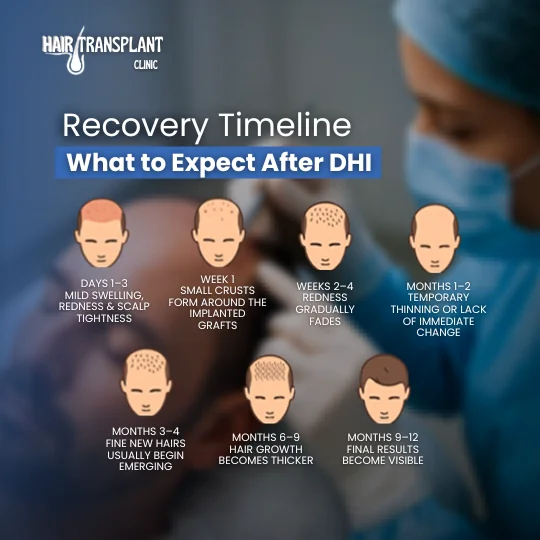
- Days 1–3: Mild swelling, redness, and scalp tightness are common during the first few days after surgery. Patients are usually advised to sleep with the head slightly elevated and avoid touching the transplanted area.
- Week 1: Small crusts form around the implanted grafts as healing begins. These crusts naturally fall away over time and should not be scratched or removed manually.
- Weeks 2–4: Redness gradually fades, and transplanted hairs may begin shedding. This temporary shedding phase, known as shock loss, is a normal part of the recovery process.
- Months 1–2: The treated area may temporarily appear unchanged or slightly thinner while the transplanted follicles enter a resting phase before new growth begins.
- Months 3–4: Fine new hairs usually begin emerging, marking the early visible stages of hair regrowth and density improvement.
- Months 6–9: Hair growth becomes thicker, fuller, and more noticeable. Most patients observe significant cosmetic improvement during this stage.
- Months 9–12: Final results become visible as the transplanted hair fully matures, blending naturally with existing hair in texture and growth pattern.
Before and After Care Tips for Best DHI Results
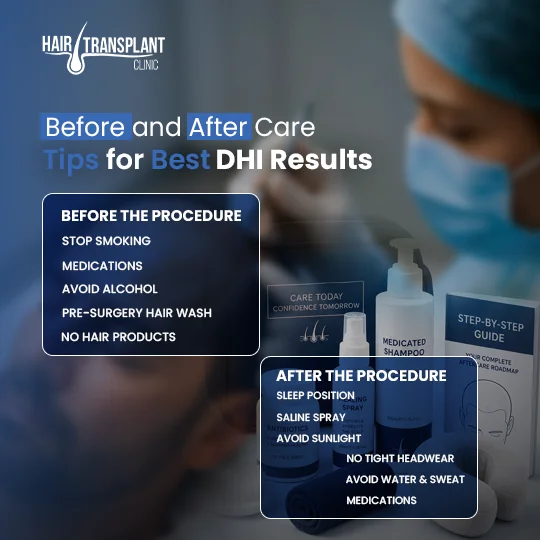
Before the procedure:
- Stop smoking: Quit smoking at least 2 weeks before surgery, as it reduces blood flow to the scalp and can negatively affect graft survival.
- Medications: Stop blood-thinning medicines such as aspirin or ibuprofen only as advised by your doctor to reduce the risk of bleeding during the procedure.
- Avoid alcohol: Do not consume alcohol for at least 1 week before surgery, as it can interfere with healing and increase bleeding risk.
- Pre-surgery hair wash: Wash your hair normally the night before the procedure to keep the scalp clean and ready for surgery.
- No hair products: Avoid applying gels, sprays, oils, or any styling products on the day of the procedure to ensure a sterile surgical environment.
After the procedure:
- Sleep position: Sleep with your head elevated for the first 3 nights to reduce swelling and protect the newly implanted grafts.
- Saline spray: Gently spray saline solution on the implanted area exactly as instructed by your surgeon to keep the scalp hydrated and support healing.
- Avoid sunlight: Do not expose your scalp to direct sunlight for at least 2 weeks, as UV exposure can irritate the healing skin.
- No tight headwear: Avoid wearing tight hats, caps, or helmets for at least 2 weeks to prevent pressure on grafts.
- Avoid water & sweat exposure: Stay away from swimming, heavy exercise, excessive sweating, and dusty environments for at least 1 month to reduce infection risk.
- Medications: Take all prescribed medications exactly as directed by your surgeon to ensure proper healing and best results.
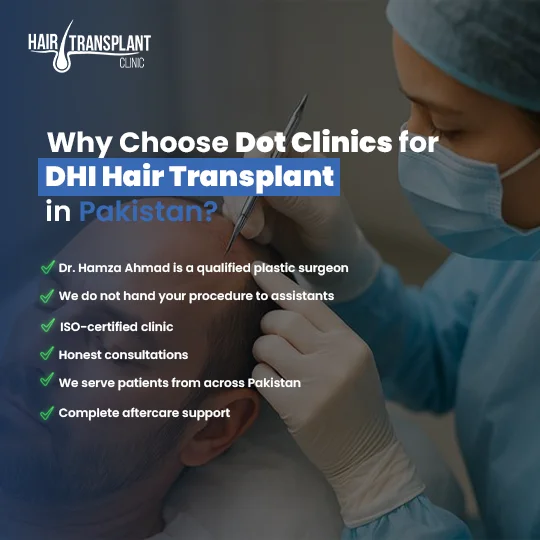
Why Choose Hair Transplant Clinic for DHI Hair Transplant in Pakistan?
There are hundreds of clinics offering hair transplant in Pakistan today. Most of them will tell you the same things. Here is what genuinely separates Dot Clinics:
- Dr. Hamza Ahmad is a qualified plastic surgeon - not a dermatologist, not a GP, not a technician. He has performed 100+ successful hair transplant procedures and brings the precision of a plastic surgeon to every session.
- We do not hand your procedure to assistants - in many clinics, the surgeon only draws the hairline and leaves the rest to technicians. At Dot Clinics, the surgeon is involved throughout.
- ISO-certified clinic - our hygiene standards, equipment, and protocols meet international certification requirements.
- Honest consultations - we tell you clearly which technique suits your condition, how many grafts you need, and what results are realistic. We do not oversell.
We serve patients from across Pakistan - from Lahore and Multan to Karachi and Islamabad. Our team accommodates out-of-city patients with scheduling and guidance.- Complete aftercare support - your care does not end when you walk out. We are available for follow-up consultations throughout your recovery journey.
DHI Hair Transplant — Frequently Asked Questions
What is DHI hair transplant and how is it different from FUE?
DHI (Direct Hair Implantation) is an advanced variation of FUE. In FUE, channels are created first and follicles are implanted afterward. In DHI, a Choi Implanter Pen is used to extract and implant grafts simultaneously, allowing more precise placement and faster healing.
Is DHI hair transplant painful?
The procedure is performed under local anesthesia, so patients do not feel pain during surgery. Only mild pressure or minor discomfort may be experienced, and most patients remain relaxed throughout the session.
How long does DHI hair transplant last?
DHI results are permanent because transplanted follicles are taken from the donor area, which is genetically resistant to hair loss. With proper care, these follicles continue to grow naturally for life.
Do I need to shave my head for DHI?
In many cases, only a small portion of the donor area needs trimming, rather than full head shaving. This makes DHI a preferred option for patients who want a more discreet procedure.
When will I see results after DHI?
New hair growth usually begins around 3–4 months after the procedure. Noticeable improvement appears by 6 months, while final results are typically seen between 9 and 12 months.
How many grafts do I need?
The required graft count depends on the size of the bald area, hair density goals, and donor hair availability. A detailed consultation is needed for an accurate assessment.
Is DHI suitable for women?
Yes. DHI is suitable for women with diffuse thinning, hairline recession, or reduced density, as it allows precise implantation between existing hairs without shaving the entire scalp.
What is the DHI hair transplant cost in Lahore?
The cost of DHI in Lahore typically ranges from PKR 150,000 to PKR 400,000, depending on graft count and procedure complexity. Final pricing is determined after consultation.
Can DHI be done for beard or eyebrows?
Yes. DHI is commonly used for beard restoration, eyebrow reconstruction, and hairline refinement due to its precision in placing grafts in small or delicate areas.
What happens if DHI fails?
True failure is rare when performed by an experienced surgeon. Temporary shedding (shock loss) within 2–4 weeks is normal and should not be mistaken for failure. Poor outcomes are usually linked to improper technique or inadequate aftercare.
Take the First Step
Ready to Get Your Hair Back?
Book your free consultation today. Our surgeon will examine your hair loss, answer all your questions, and give you an honest plan, with no pressure and no commitment.
Book Free Consultation Now
Our Contacts
- 85-R1, Ground Floor, Phase 2, Johar Town, Lahore
Get directions on the map - +92-329-001-1336
,
(24/7 General inquiry) - info@hairtransplantclinic.pk
Why Hair Transplant Clinic?
Hair Transplant Clinic is Pakistan’s largest hair loss treatment center, and proud of delivering the best
results as promised!
We bring you reliable alternatives to the scary cosmetic surgeries.