Request Form
Emergency Case
Emergency hair loss care may be needed if you have had a blow to the face, lost a filling, or cracked a tooth.
- 0329-0011336
0327-0011335 - info@dotclinics.pk
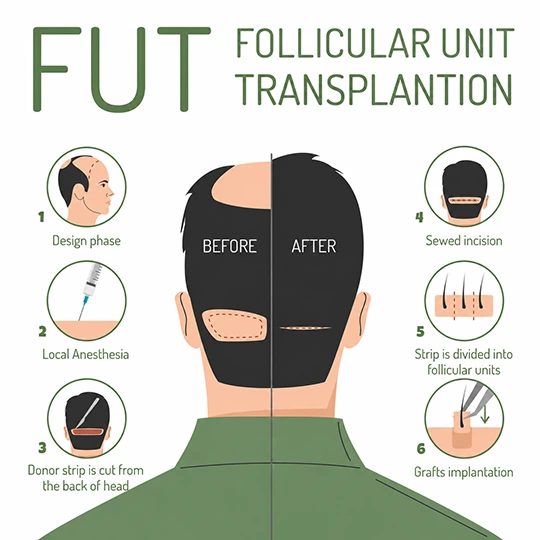
FUT Hair Transplant in Pakistan
FUE, DHI & FUT Treatment | Expert Hair Transplant Clinic in Lahore
If you are losing your hair and wondering whether anything can actually fix it permanently — the answer is yes. FUT hair transplant moves your own living hair follicles from where they will never go bald to where they already have. The results grow, look, and feel exactly like real hair — because they are. Available at our clinics in Lahore.
- 98% Graft Survival Rate
- 4000+ Grafts in One Session
- 100+ Procedures Done
- 10+ Years Experience
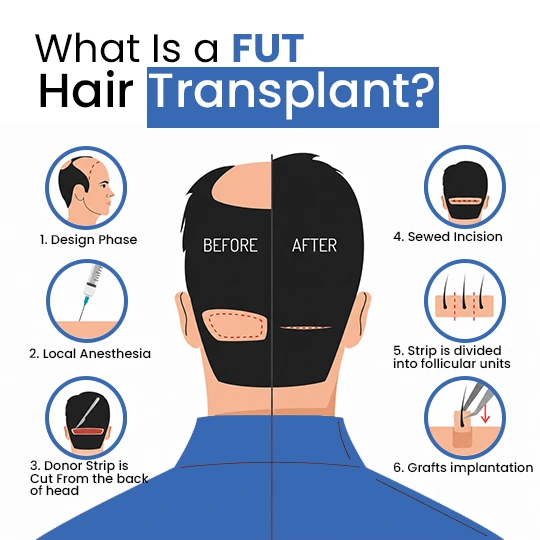
What Is a FUT Hair Transplant?
FUT (Follicular Unit Transplantation) is a surgical hair restoration procedure where a thin strip of scalp is removed from the back of your head, divided under a microscope into individual hair grafts of one to four follicles each, and implanted into bald or thinning areas. It is also called the strip hair transplant or strip method. The donor zone at the back of your scalp is genetically programmed never to bald, so once those follicles are moved, they keep growing permanently in their new location, looking and feeling exactly like your natural hair.
FUT is the preferred technique when you need a large number of grafts, typically 2,500 to 4,500, in a single session. It delivers higher graft yield per sitting than FUE, with one of the best graft survival rates of any hair restoration procedure, thanks to microscopic dissection that protects each follicular unit from the moment it leaves the donor strip.
schedule a visitHow FUT Hair Transplant Works Step by Step
The whole procedure takes 6–8 hours under local anesthesia. You are awake, comfortable, and go home the same day.
Your surgeon assesses your hair loss pattern, measures donor density, and designs a hairline proportional to your face and age. The graft estimate is confirmed here.
The donor area is numbed with local anesthesia. A brief sting at the injection, then nothing. You feel no pain throughout the procedure.
A thin strip of scalp (1–1.5 cm wide) is removed from the safe donor zone. The wound is closed using trichophytic closure, a suturing technique that allows hair to grow through the scar line, making it nearly invisible under normal hair length.
The strip is divided under high-powered microscopes into individual follicular units. This controlled dissection is why FUT produces superior graft survival, follicles stay intact and protected from the moment they are harvested.
Tiny incisions are made in the recipient area at precise angles matching your natural hair growth direction. This step determines how natural the final result looks.
Single hair grafts are placed at the hairline edge; multi-hair units fill the area behind for density. Every graft placed is deliberate, direction, depth, and spacing all controlled by the surgeon.
The donor area is lightly dressed. You leave with written aftercare instructions and return at day 10–14 for stitch removal. Most patients are back at a desk job within 5–7 days.

Who Is a Good FUT vs FUE Hair Transplant, Key Differences
Neither method is universally better. FUT wins on graft volume, cost, and survival rate. FUE wins on faster recovery and no linear scar. The right choice depends on your hair loss stage and lifestyle, your surgeon confirms which fits you after examining your scalp.
Women who are good candidates:
- Feature FUT (Strip Method) FUE Hair Transplant
- How grafts are removed Strip of scalp removed, then divided into grafts Individual follicles extracted one at a time
- Grafts per session 2,000 – 4,000+ in one sitting Up to 2,500 per session on average
- Scarring One thin linear scar (hidden under hair) Tiny dot scars spread across donor area
- Graft survival rate Very high, grafts protected during extraction High, depends on surgeon skill
- Recovery time Stitches out at 10–14 days; slightly longer healing Faster, no stitches needed
- Cost per graft More affordable for large sessions Slightly higher per graft
- Shaving required No full shaving needed, only a narrow strip Usually requires shaving entire donor area
- Best for Advanced baldness, large coverage needed Mild to moderate hair loss, active lifestyle
Patients needing 3,000+ grafts almost always get better value from FUT, more coverage, one session, lower total cost. Patients with mild loss or a preference for very short hair may suit FUE better. Some cases benefit from combining both. Your free consultation gives you a clear recommendation based on your specific scalp.
Benefits of FUT Hair Transplant
FUE gets more marketing attention. But for patients with significant hair loss, experienced surgeons still recommend FUT first — for these reasons.
Up to 4,500 Grafts in One Session
FUT yields more grafts per sitting than any other technique. Patients with advanced baldness get full coverage in a single procedure instead of splitting across multiple FUE sessions.
Highest Graft Survival Rate
Grafts are dissected under microscopes in a controlled environment, not extracted individually and exposed one by one. This is why FUT consistently delivers superior follicle survival rates compared to FUE for large sessions.
Most Cost-Effective for Large Coverage
More grafts per session means fewer sessions overall. If you need 3,000 grafts, FUT does it in one sitting. The same coverage with FUE may require two procedures, doubling your cost and recovery time.
No Full Head Shave Required
FUT only trims a narrow strip at the donor site. Your surrounding hair covers it immediately. FUE requires shaving the entire back of the scalp. For women and anyone wanting discretion, FUT is the practical choice.
Consistent Graft Quality
All grafts are dissected at the same time by the same team under the same conditions. Quality stays consistent from the first follicle to the last, unlike long FUE sessions where graft condition can decline over time.
30+ Years of Documented Results
FUT has been performed since the early 1990s with extensive long-term outcome data. Surgeons know exactly what patients can expect at 6, 12, and 120 months post-procedure. There is no guesswork in the outcome.
Why Patients From Across Pakistan Choose Us
There are dozens of clinics in Pakistan offering hair transplants. Here is an honest account of what we do differently, and why it matters to your result.
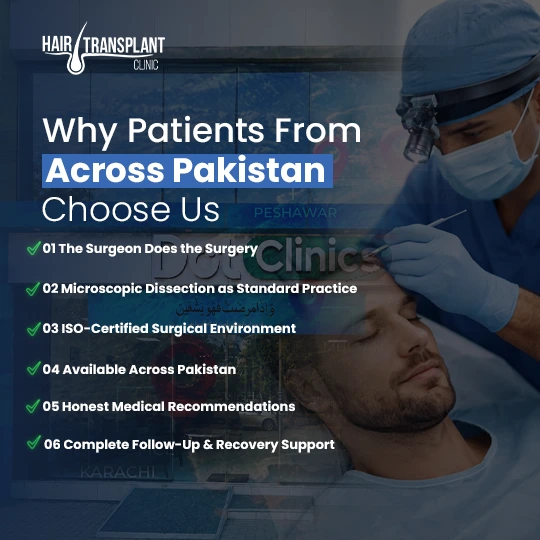
- 01 The Surgeon Does the Surgery: At many clinics, technicians handle most of the procedure after the consultation. At our clinic, Dr. Hamza Ahmad — a certified plastic surgeon with 10+ years of experience — personally performs your FUT hair transplant from start to finish. He designs your hairline, removes the donor strip, creates recipient sites, and supervises every graft placement for natural, consistent results.
- 02 Microscopic Dissection as Standard Practice: Every graft is dissected under high-powered stereo microscopes to protect follicle integrity and maximise graft survival. This internationally accepted FUT standard helps reduce follicle damage before implantation.
- 03 ISO-Certified Surgical Environment: Our clinics follow strict sterilisation and surgical safety protocols in an ISO-certified environment. Controlled operating conditions and proper aftercare reduce risks and support smooth recovery.
- 04 Available Across Pakistan: We provide FUT hair transplant services in Lahore, Karachi, Islamabad, and Multan, allowing patients to access high-quality treatment locally without travelling abroad.
- 05 Honest Medical Recommendations: Not every patient is an ideal candidate for FUT. In some cases, we may recommend FUE, non-surgical treatment, or delaying surgery depending on your hair loss pattern and donor area condition. Our focus is long-term results, not unnecessary procedures.
- 06 Complete Follow-Up & Recovery Support: Hair transplant recovery continues for months after surgery. Our team stays connected with you throughout the growth journey, providing guidance, follow-up assessments, and ongoing support whenever needed.
FUE Hair Transplant — Frequently Asked Questions
Is a FUT hair transplant painful?
FUT hair transplant surgery is performed under local anaesthesia, so patients generally do not feel pain during the procedure. Mild soreness, tightness, or discomfort may occur during the first few recovery days and is usually manageable with prescribed medication.
How long does the FUT procedure take?
Most FUT hair transplant procedures take between 6 to 8 hours depending on the number of grafts required. Larger sessions may take slightly longer, with scheduled breaks provided during the procedure.
Will the FUT scar be visible?
FUT leaves a fine linear scar in the donor area, but it is usually hidden beneath surrounding hair. Advanced closure techniques such as trichophytic closure help minimise the scar's appearance over time.
Can women undergo FUT hair transplant surgery?
Yes. FUT is often a suitable option for women because the donor area usually does not require complete shaving. Existing hair can often conceal the donor area during recovery.
How many FUT sessions will I need?
Many patients achieve their desired coverage and density in a single FUT session. Patients with advanced hair loss may require a second session after full healing and hair growth development.
Should I choose FUT or FUE?
The ideal technique depends on your hair loss pattern, donor hair quality, hairstyle preference, and treatment goals. FUT is commonly recommended for larger graft sessions, while FUE may suit patients preferring shorter hairstyles and minimal visible scarring.
Are FUT hair transplant results permanent?
Yes. FUT uses hair follicles from the permanent donor zone, which is naturally resistant to DHT-related hair loss. Once transplanted, these follicles typically continue growing permanently in the new area.
What is the difference between FUT and strip hair transplant?
There is no difference. “Strip hair transplant” is another commonly used term for FUT (Follicular Unit Transplantation) because the procedure involves removing a thin strip of scalp from the donor area.
When will I see my final FUT results?
Transplanted hair usually sheds during the first few weeks after surgery, which is a normal part of the process. New hair growth often begins around months 3 to 4, with noticeable improvement by month 6 and final mature results visible after 12 months.
Take the First Step
Ready to Get Your Hair Back?
Book your free consultation today. Our surgeon will examine your hair loss, answer all your questions, and give you an honest plan, with no pressure and no commitment.
Book Free Consultation Now
Our Contacts
- 85-R1, Ground Floor, Phase 2, Johar Town, Lahore
Get directions on the map - +92-329-001-1336
,
(24/7 General inquiry) - info@hairtransplantclinic.pk
Why Hair Transplant Clinic?
Hair Transplant Clinic is Pakistan’s largest hair loss treatment center, and proud of delivering the best
results as promised!
We bring you reliable alternatives to the scary cosmetic surgeries.