Request Form
Emergency Case
Emergency hair loss care may be needed if you have had a blow to the face, lost a filling, or cracked a tooth.
- 0329-0011336
0327-0011335 - info@dotclinics.pk
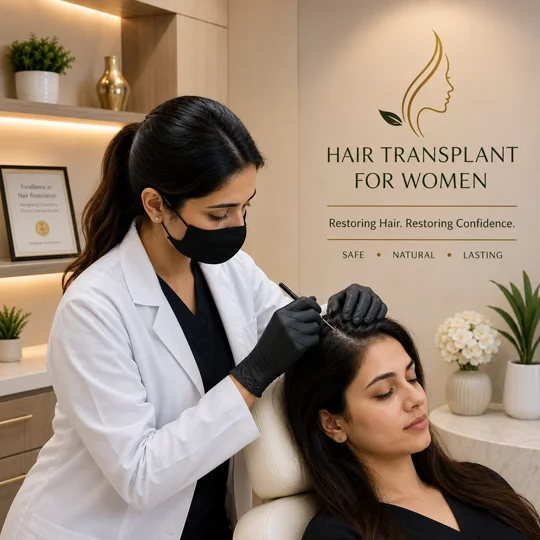
Hair Transplant For Women
FUE, DHI & FUT Treatment | Expert Hair Transplant Clinic in Lahore
Hair transplant for women is a safe and effective solution for thinning hair and hair loss. At our clinic, we focus on natural-looking results that help restore your hair and confidence. Most women do not need a full head shave making the recovery easier and more comfortable. Using advanced FUE and FUT techniques healthy hair follicles are transplanted into thinning areas to create fuller denser hair growth. Our treatments are customized to match your face shape and hair pattern.
Restore thicker, natural-looking hair without a full head shave. Trusted by women across Pakistan for safe, permanent results.
- 🏥 Certified Hair Surgeons
- 💆♀️ No Full Head Shave Required
- ✅ 95%+ Patient Satisfaction

Hair Loss in Women Is More Common Than You Think
Almost 1 in 5 women experience noticeable hair loss at some point in their life. Unlike men, women rarely develop a fully bald patch. Instead, the hair becomes thinner, especially along the parting line, crown, and top of the scalp, while the front hairline stays mostly the same.
This type of hair loss is called female pattern hair loss or female androgenetic alopecia. It develops slowly, often starting in your 30s or 40s, and can become more noticeable after pregnancy, menopause, or during periods of high stress.
A female hair transplant moves healthy hair follicles from a thicker area of your scalp — usually the back or sides — and places them into the thinning areas. The transplanted hair grows naturally for life and looks completely real.
🌟 Good news: Most women having a hair transplant in Pakistan do not need to shave their entire head. Only a small hidden area is trimmed, so you can return to daily life quickly and discreetly.
schedule a visitCommon Causes of Female Hair Loss
Hair loss in women can start for many different reasons. Knowing the cause helps us plan the right treatment for you.
Family History (Genetics)
If your mother, grandmother, or other female relatives experienced hair thinning, you may be more likely to develop the same condition. Hereditary hair loss in females, also called androgenetic alopecia, is the most common cause of diffuse thinning in women.
Hormonal Changes
Pregnancy, menopause, thyroid problems, and conditions like PCOS (polycystic ovary syndrome) all affect the hormones that control hair growth. When these hormones go out of balance, the hair growth cycle slows down and hair starts to thin.
Medical Conditions
Autoimmune diseases such as alopecia areata and lupus can cause patchy hair loss. Anaemia (low iron levels) and vitamin deficiencies, especially vitamin D, B12, and zinc, are also very common triggers that are often missed.
Medical Treatments
Chemotherapy and radiation therapy are well-known causes of hair loss. Some blood pressure medications, antidepressants, and hormonal pills can also cause increased shedding. This is called medication-induced hair loss, and it may or may not be permanent.
Stress and Lifestyle
Severe stress, extreme dieting, or sudden weight loss can push large numbers of hair follicles into a resting phase, causing heavy shedding a few months later. This is called telogen effluvium. Poor nutrition, especially low iron, zinc, or protein, makes it worse.
Ageing
After the age of 40 to 50, many women notice the hair naturally becomes finer and less dense. This gradual thinning is a normal part of ageing, but it can still be treated effectively with the right hair restoration approach.
Tight Hairstyles (Traction Alopecia)
Wearing tight braids, ponytails, or hair extensions for many years puts constant tension on the hair roots. Over time this can permanently damage the follicles and cause hairline recession, particularly around the temples and edges.
Postpartum Hair Loss
Many women experience heavy hair shedding 2 to 4 months after giving birth. This happens because oestrogen levels drop sharply after delivery. In most cases the hair grows back on its own, but some women find the density never fully returns, especially if there is an underlying condition.
Who Is a Good Candidate for Female Hair Transplant?
Not every woman experiencing hair loss needs, or is ready for, a transplant. Here is what we look for during your consultation.
Women who are good candidates:
-
🗸
Women with a stable, healthy donor area at the back or sides of the scalp
-
🗸
Those with female pattern hair loss (diffuse thinning at the crown or parting line)
-
🗸
Women with traction alopecia from years of tight hairstyles
-
🗸
Those who have lost hair due to scarring, burns, or previous surgery
-
🗸
Women with a receding frontal hairline who want natural restoration
-
🗸
Those whose hair loss has been stable for at least 12 months
-
🗸
Women in overall good health with realistic expectations
-
🗸
Those who have tried medical treatments but not seen enough improvement
When a transplant may not be the right first step:
-
✗
Actively spreading or unstable hair loss, the cause must be treated first
-
✗
Very diffuse thinning across the entire scalp with no healthy donor area
-
✗
Uncontrolled medical conditions like unmanaged thyroid disease or severe anaemia
-
✗
Alopecia areata in an active phase, results are unpredictable
-
✗
During pregnancy or breastfeeding
💡 Not sure if you qualify? Our hair specialist will assess your scalp, donor area, and medical history in a free consultation before recommending any treatment. There is no pressure to proceed.
Our Female Hair Transplant Techniques
We offer multiple methods so your treatment can be matched to your hair type, area of loss, and daily lifestyle.
FUE (Follicular Unit Extraction)
Individual hair follicles are removed one by one from the donor area using a tiny punch tool, then planted into the thinning areas. There is no visible linear scar, the recovery is quick, and results look completely natural.
Best for: Most women, especially those with mild to moderate thinning or a limited donor area.
FUT (Follicular Unit Transplantation)
A thin strip of hair-bearing scalp is removed from the back of the head, then carefully divided into individual grafts. This method allows a large number of grafts to be transplanted in one session.
Best for: Women with significant thinning who need a high number of grafts in a single visit.
DHI (Direct Hair Implantation)
Hair follicles are extracted and then placed directly into the scalp using a specialized pen-shaped implanter. This gives the surgeon very precise control over the angle and direction of each hair, creating a natural hairline.
Best for: Frontal hairline restoration and areas requiring very fine, detailed work.
Sapphire FUE
The same as FUE, but the surgeon uses blades made from sapphire stone to create the tiny channels where hairs are planted. Sapphire creates cleaner, finer incisions — which means less swelling, faster healing, and higher density results.
Best for: Women who want maximum density and the quickest possible recovery.
IFA (Implanter Follicular Approach)
A refined implantation technique where grafts are placed with precision instruments to control the exact depth, direction, and spacing of each hair. This produces very natural-looking results and improves graft survival.
Best for: Cases requiring highly detailed, natural-looking hairline design.
PRP Therapy (Hair Growth Booster)
Platelet-Rich Plasma (PRP) therapy uses your own blood to encourage the scalp to heal faster and support new hair growth. It is often combined with a hair transplant to improve graft survival and speed up results.
Best for: Women who want to boost their transplant results or strengthen existing thin hair.
How the Procedure Works
Our specialist assesses your scalp, donor area density, and pattern of hair loss using trichoscopy. We explain all hair transplant techniques suitable for your case and set realistic expectations.
On the day of the procedure, the donor area is trimmed (just a small hidden section — not your whole head) and the scalp is cleaned. Local anaesthesia is applied so you feel comfortable throughout. The procedure typically takes 4 to 8 hours depending on the number of grafts.
Individual hair follicles are carefully removed from the donor area using the chosen technique, FUE, FUT, or DHI. Each graft is handled gently and stored in a special solution to keep the follicles healthy and alive.
Before implanting, your surgeon draws a natural-looking hairline that suits your face shape. The grafts are then carefully placed into the thinning areas at the correct angle and depth to mimic your natural hair growth pattern.
Each hair graft is implanted at the precise angle, depth, and direction that mirrors your natural hair growth pattern, ensuring seamless blending with existing hair.
You go home the same day. Our team gives you detailed written aftercare instructions, a follow-up schedule, and direct access to contact us if you have any concerns. Most women return to normal activities within 7 to 10 days.
Female Hair Transplant, Results Timeline
Hair growth after a transplant follows a predictable timeline. Patience is key, the best results come after 9 to 12 months.
-
Week 1-2
Mild redness and small scabs form around the implanted area. This is completely normal and settles quickly. -
Week 2-6
The transplanted hairs shed. Do not worry, this is a normal part of the process. The follicle roots remain alive under the scalp. -
Month 3-4
New fine hairs begin to emerge. Growth is slow and uneven at this stage, which is completely expected. -
Month 6
Noticeable improvement in hair coverage. Around half of the final result is visible by this point. -
Month 9-12
Full, natural-looking results. Hair texture matures and density reaches its final thickness. -
Beyond 1 Year
Transplanted hair continues to grow naturally for life — it can be cut, styled, and washed like your own hair.
🔎 Important: Every woman's hair grows at a different speed. Some see results earlier, some a little later. Our team monitors your progress at every follow-up appointment to make sure everything is on track.
Not Sure If You Qualify?
Book a free, no-obligation consultation at our Lahore clinic. Our hair transplant doctor will assess your hair loss grade using the Norwood scale and tell you exactly what is achievable for your specific case.
You will receive a personalised treatment plan with graft estimates, technique recommendation, and transparent pricing — all at no cost.
Book Free ConsultationFemale Cost in Pakistan Hair TransplantCost in Pakistan
The cost depends on how many grafts you need and which technique is used. We always give you a fixed price before starting, no surprises.
-
500 – 1,000 Grafts
PKR 80,000 – 120,000Hairline or small thinning patch.
-
1,000 – 2,000 Grafts
PKR 120,000 – 200,000Crown or moderate thinning.
-
2,000 – 3,000 Grafts
PKR 200,000 – 300,000Wider diffuse thinning.
-
3,000+ Grafts
Discussed at ConsultationAdvanced hair loss or large area.
💡 These are estimated ranges. Your exact cost is confirmed during your free consultation based on your scalp assessment. We offer flexible payment options for eligible patients.
What affects the cost?
- The number of grafts needed to cover your thinning area
- The technique chosen, DHI and Sapphire FUE require more precision and may cost slightly more
- Whether PRP therapy is added to support the transplant
- The experience and qualifications of your surgeon
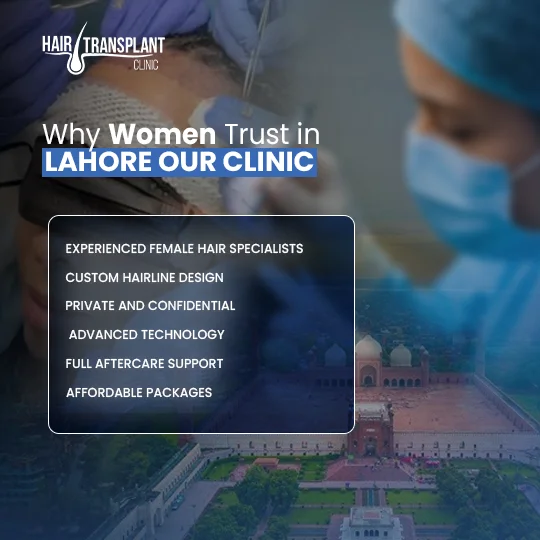
Why Women Trust in Lahore Our Clinic
We understand that choosing a hair transplant is a big decision. Here is what makes us different.
- 👩⚕️ Experienced Female Hair Specialists: Our surgeons have extensive experience in treating female hair loss specifically, not just adapting male techniques.
- 🎨 Custom Hairline Design: Every hairline is designed to match your face shape and natural hair pattern. No two procedures are the same.
- 🔒 Private and Confidential: We understand that hair loss is personal. Your consultations, procedure, and results are handled with complete discretion.
- 💉 Advanced Technology: We use Sapphire FUE, DHI implanter pens, and PRP support, the same advanced methods used by top clinics internationally.
- 📞 Full Aftercare Support: We stay with you throughout your recovery, regular follow-up appointments and direct contact with your care team.
- 💰 Affordable Packages: World-class results at Pakistan pricing. We offer transparent costs and flexible payment plans, no hidden fees.
Frequently Asked Questions
Everything you need to know before starting your hair transplant journey in Pakistan.
Is a female hair transplant permanent?
Yes. The hair follicles transplanted from the donor area are genetically resistant to the hormones that cause hair thinning. Once they are moved to the thinning area and grow, they continue growing naturally for the rest of your life. The transplanted hair can be cut, coloured, and styled just like your natural hair.
Will I need to shave my head?
No, not your entire head. In most female hair transplants, only a small area at the back of the scalp (the donor area) is trimmed short. The surrounding hair covers it immediately, so most women are comfortable going out in public within a few days of the procedure.
Is the procedure painful?
The scalp is made numb using local anaesthesia before the procedure starts. You may feel mild pressure during the process but you should not feel any sharp pain. After the anaesthesia wears off in the evening, there may be some mild soreness for a day or two, this is easily managed with simple pain relief medication provided by our team.
Which technique is best for women — FUE or FUT?
FUE is the most popular choice for women because it leaves no visible scar and allows a faster, more comfortable recovery. However, FUT may be recommended when a large number of grafts are needed in a single session. Our surgeon will assess your specific hair loss pattern and donor area and recommend the most suitable technique for you.
How much does a female hair transplant cost in Pakistan?
The cost in Pakistan typically ranges from PKR 80,000 to PKR 300,000 depending on the number of grafts required, the technique used, and the experience of the surgeon. Women with diffuse thinning often need a customised plan, so the final price is confirmed after a scalp assessment. Our clinic provides a full cost breakdown at your free consultation — no hidden charges.
Can women with PCOS or thyroid problems get a hair transplant?
Yes, but the underlying condition should be managed first. If your hair loss is still actively progressing due to uncontrolled hormonal issues, the transplant results may not be as stable. We recommend a medical review and, if needed, coordination with your doctor before proceeding with surgery. Once your condition is stable, a hair transplant can give excellent, long-lasting results.
When will I see the final results?
Most women start seeing noticeable improvement around the 6-month mark. Full, mature results — with the final thickness and natural look, are typically visible between 9 and 12 months after the procedure. Hair growth is gradual, so patience is important. Our team will monitor your progress at every follow-up visit.
Is female hair transplant successful in Pakistan?
Yes. With a skilled, experienced surgeon and proper aftercare, female hair transplant success rates in Pakistan are very high, comparable to international standards. The key factors are choosing a qualified clinic, having a healthy donor area, and following post-operative care instructions carefully.
What is the recovery time for women after a hair transplant?
Most women are comfortable returning to light work and normal daily activities within 7 to 10 days. Strenuous exercise, swimming, and direct sun exposure should be avoided for 3 to 4 weeks. The small scabs that form in the transplanted area fall off naturally within 10 to 14 days and should not be picked or scratched.
Ready to Get Your Hair Back?
Book a free, no-pressure consultation at our Lahore clinic. Our specialist will assess your scalp, answer all your questions, and explain exactly what is possible for you, with no obligation to proceed.
Book Your Free ConsultationReady to Get Your Hair Back?
Book a free, no-pressure consultation at our Lahore clinic. Our specialist will assess your scalp, answer all your questions, and explain exactly what is possible for you — with no obligation to proceed.
Book Free Consultation
Our Contacts
- 85-R1, Ground Floor, Phase 2, Johar Town, Lahore
Get directions on the map - +92-329-001-1336
,
(24/7 General inquiry) - info@hairtransplantclinic.pk
Why Hair Transplant Clinic?
Hair Transplant Clinic is Pakistan’s largest hair loss treatment center, and proud of delivering the best
results as promised!
We bring you reliable alternatives to the scary cosmetic surgeries.